How It Works
Verifiable, cryptographically fair draws here's exactly how.
Most free draw tools give you a result and ask you to trust it. This one gives you a public record anyone can verify. Here is what happens between clicking "Draw Winner" and sharing that link.
Step one: paste your entries
The entry field accepts plain text one name or ticket number per line. You can type them directly, or copy a column from Excel or Google Sheets and paste it in. The tool handles commas, tabs, and extra whitespace automatically, so you don't need to clean up your spreadsheet first. There is no account to log into, no file to upload, and no format to match. If you have a list of names and five seconds, you have enough to run a draw.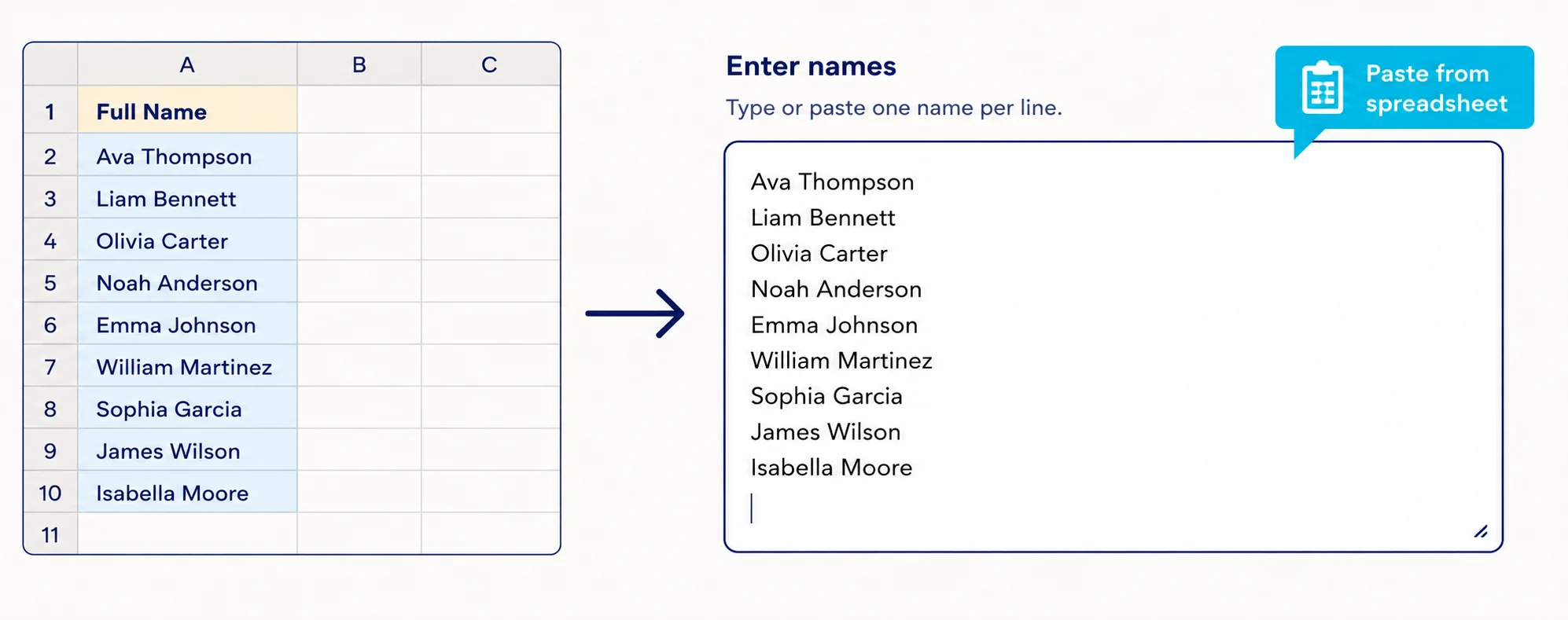
Step two: choose your draw mode
Four modes cover the raffle formats that actually come up in practice:- Name Draw paste any list of names, choose how many winners, draw. Works for any size from ten entries to ten thousand.
- Ticket Number Draw enter the range of numbers you sold (say, 1 through 500) and draw winning numbers. No list needed.
- Multi-Prize Draw draw a separate unique winner for each prize tier in a single session. Label your prizes with the actual prize names so the result record is meaningful.
- Card Draw a full 54-card deck for Queen of Hearts raffles. Reveal cards one at a time click individual cards or use Draw Random for an automated weekly reveal.
Why crypto.getRandomValues() not Math.random()
This is the part that separates a serious draw tool from a novelty spinner.
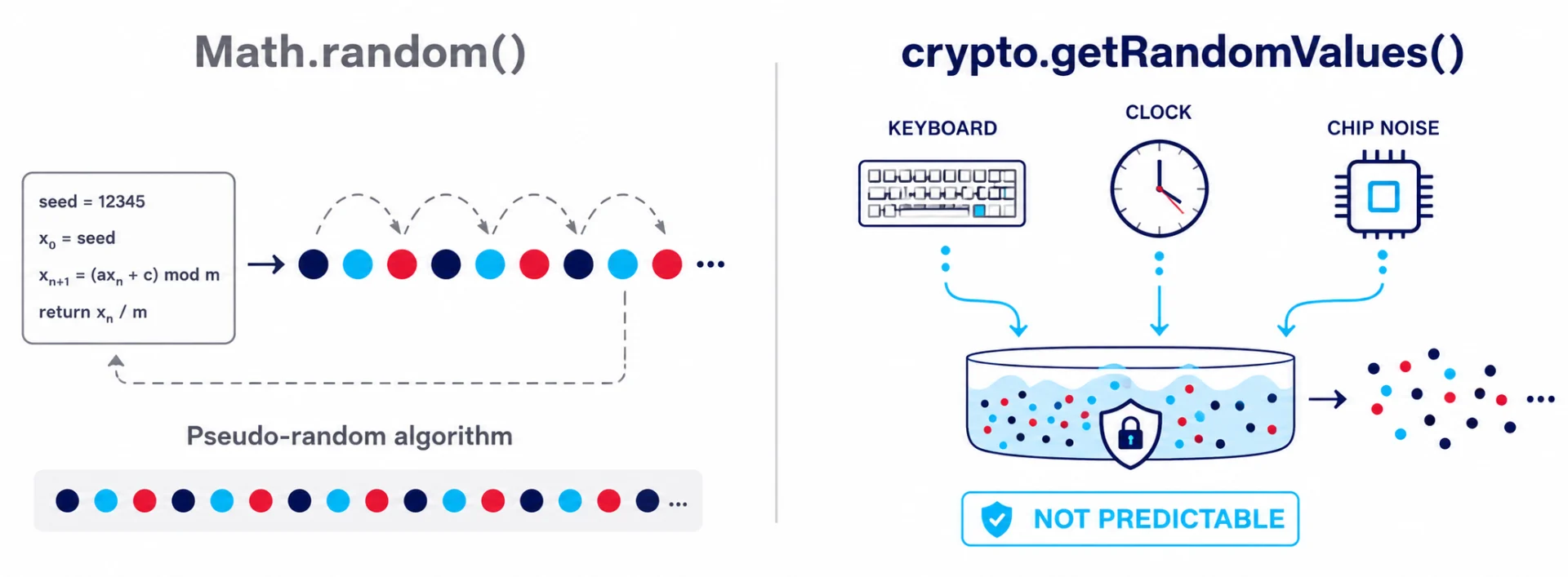
Most free "random winner" tools on the web use JavaScript's built-in Math.random() function. It works fine for casual use, but it has a known limitation: it generates numbers using a pseudo-random algorithm a mathematical formula seeded with a starting value. If someone knows the seed and the algorithm, they can reproduce or predict the output.
For a personal giveaway with friends, that probably does not matter. For a nonprofit raffle where the result affects real money and your organization's credibility is on the line, it matters a great deal.
How
This is the same randomness standard used in cryptographic applications: generating encryption keys, creating secure tokens, and protecting financial transactions. We use it for raffle draws because a raffle is a promise, and a promise deserves to be kept with something more rigorous than a guess.
crypto.getRandomValues() is differentThis API draws randomness from the operating system's entropy pool a hardware-level source that collects genuine unpredictability from events like keyboard timing, mouse movement, and hardware interrupts. The result cannot be predicted, reproduced from a formula, or reverse-engineered. No one including the person running the draw can know the winner before the draw happens.
| Property | Math.random() |
crypto.getRandomValues() |
|---|---|---|
| Randomness source | Pseudo-random algorithm | OS entropy pool / hardware |
| Predictable from seed? | Yes, in theory | No not reproducible |
| Statistical quality | Sufficient for casual use | Cryptographic standard |
| Used in security apps? | No | Yes encryption, tokens |
| Appropriate for regulated raffles? | Questionable | Yes |
The verifiable draw ID what it is and what it proves
Every draw this tool performs creates two things: a winner, and a record. The record lives at a permanent public URLrafflegenerator.com/verify/[draw-id] and contains everything anyone needs to independently confirm the draw was conducted as described.
Example Draw Verification Record
Here is what each field in that record proves:
C2W-A3F7E219C04B8D1A
rafflegenerator.com/verify/a3f7e219c04b8d1a
Entry count
247 entries
Draw timestamp
Apr 23, 2026 · 2:14:07 PM EST
Entry list hash (SHA-256)
8f3a9b2c…d7e1f4a0
Winner
Angela Torres
Entry count
The number of entries that were in the draw pool. If you told participants there were 247 entries and the verify record shows 247, they know the pool wasn't manipulated. If those numbers don't match, something is wrong and the record makes that visible.Draw timestamp
The exact moment the draw was performed, recorded to the second. This matters for raffles with a published draw deadline. If your rules said "drawing at 5:00 PM on April 23" and the verify record shows 2:14 PM on the same day, participants know the draw happened before the advertised time. Timestamps keep organizers accountable.Entry list hash
This is the privacy-preserving element. We do not store anyone's name or ticket number. Instead, the system generates a SHA-256 hash of the complete sorted entry list a mathematical fingerprint unique to that exact list in that exact order. If you change even one character in the entry list, the hash changes completely. This means participants can verify "247 people were in this draw" and "the entry list was not changed after the draw was scheduled" without the tool ever knowing who those people are.Winner
The result of the draw, tied immutably to the timestamp and entry hash. The winner field cannot be edited after the draw is complete without invalidating the hash, which would be immediately obvious to anyone checking the verify record.Why this matters for regulated rafflesMany state charitable gaming regulations require organizations to document their draw procedure and retain records for a period after the event. Some states (Colorado and Kentucky among them) require in-person physical drawings in which case the Chance2Win managed platform handles that compliance path separately. For online draws in states that permit them, the verify record provides exactly the kind of timestamped, auditable documentation regulators look for. It is not a substitute for legal counsel always check your state's specific requirements but it is far more defensible than a screenshot of a spinner.
Step four: share the result link
Once a draw is complete, the result zone shows a Copy Result Link button. That copies the full verify URL to your clipboard something likehttps://rafflegenerator.com/verify/a3f7e219c04b8d1a.
You can paste that link anywhere:
- Post it directly in the comments of your raffle announcement on Facebook or Instagram
- Include it in the winner notification email to all participants
- Add it to your raffle page or website alongside the winner announcement
- Screenshot the verify page itself if you prefer an image for social sharing
A note on announcing winnersBefore posting a winner's full name publicly, get their consent. Sharing first name and last initial "Angela T. from Apollo Beach, FL" protects privacy while still making the result feel real and human. If you can get a photo of the prize presentation, use it. Nothing builds trust for your next raffle like a smiling winner holding their prize with a link to the verify record beside it.
Your entry list stays private
The draw runs entirely in your browser. Your names and ticket numbers are never transmitted to our servers in readable form. The only data the verification system logs is the SHA-256 hash of your entry list, the entry count, the timestamp, the draw seed, and the winner nothing that would allow us or anyone else to reconstruct your participant list. For nonprofit organizers managing donor data, this matters. Your supporters' names are yours to manage, not ours to store.When a draw tool isn't enough
This tool is for drawing from an existing list. It does not sell tickets, collect payments, manage entries, or handle the raffle itself. If you need any of those things, you need a platform not a draw tool. The difference is straightforward:- You already have your entries and need a fair draw → use this tool, it's free.
- You need to sell tickets to the public, collect payments, and then draw → you need a full raffle platform.
Frequently asked questions
What is crypto.getRandomValues() and why does it matter?
crypto.getRandomValues() is a cryptographic randomness API built into modern browsers. It generates random numbers from a hardware or OS-level entropy source, producing results that cannot be predicted or reproduced. This is meaningfully different from Math.random(), which uses a pseudo-random algorithm with known statistical properties. For a raffle draw, cryptographic randomness means no one not even the person running the tool can know or influence the outcome in advance.
What does the verifiable draw ID actually prove?
The draw ID links to a permanent public record containing the entry count, exact timestamp, SHA-256 hash of the entry list, and the winner. Anyone with the URL can verify that the draw happened at the stated time, with the stated number of entries, and produced the stated result. It cannot be altered after the fact without changing the hash, which would be immediately visible to anyone checking.
Are my entry names stored on your servers?
No. Entries are processed in your browser and never sent to our servers in readable form. The verification record stores a SHA-256 hash of the sorted entry list a mathematical fingerprint not the actual names or ticket numbers. This allows independent verification of the entry count without storing any personal information.
Is the verify link permanent?
Yes. Every draw ID and its verify record is stored permanently at rafflegenerator.com/verify/[id]. You can share the link weeks or months after the draw and participants can still inspect the full record.
Can I use this tool for a regulated charitable gaming raffle?
This tool generates auditable draw records suitable for many compliance situations, but raffle laws vary significantly by state and we are not lawyers. Some states (Colorado and Kentucky in particular) require physical in-person drawings in those cases the draw tool alone will not satisfy that requirement. For fully managed compliance, the Chance2Win platform handles state-specific requirements as part of the onboarding process. Always consult your state's charitable gaming regulator or an attorney familiar with your jurisdiction before running a paid raffle.
Ready to draw?
Try the generator it takes about thirty seconds.
No signup. No tips. Free. If you need a full raffle platform after that, we can help with that too.