Is Zeffy really free?
Yes Zeffy charges nonprofits nothing. But their revenue comes from asking your donors for a 17–29% tip at the moment of checkout. Here is what that actually does to your fundraising total, with real numbers.
The honest answer: it depends on your raffle size
We are going to give Zeffy something most comparison articles won't a fair assessment of when it makes sense before we get into the math that shows when it doesn't. Zeffy is a reasonable choice if: your raffle goal is under approximately $5,000, the format is a simple traditional draw, your donors are highly motivated and unlikely to abandon at checkout, and you have no need for basket raffles, Queen of Hearts, or specialty formats. For that specific scenario, the simplicity and zero upfront cost may outweigh the abandonment risk.How Zeffy's business model actually works
Zeffy is genuinely free to nonprofits in the sense that they charge zero platform fees, zero subscription fees, and zero transaction percentages to the organization. That part is accurate advertising. What Zeffy doesn't lead with is how they make money: by presenting donors with a tip prompt at the final step of checkout. The default tip is pre-checked at a rate between 17% and 29% depending on the transaction. Donors can decline the tip, but they have to actively do so and by the time the tip appears, they have already entered their card details.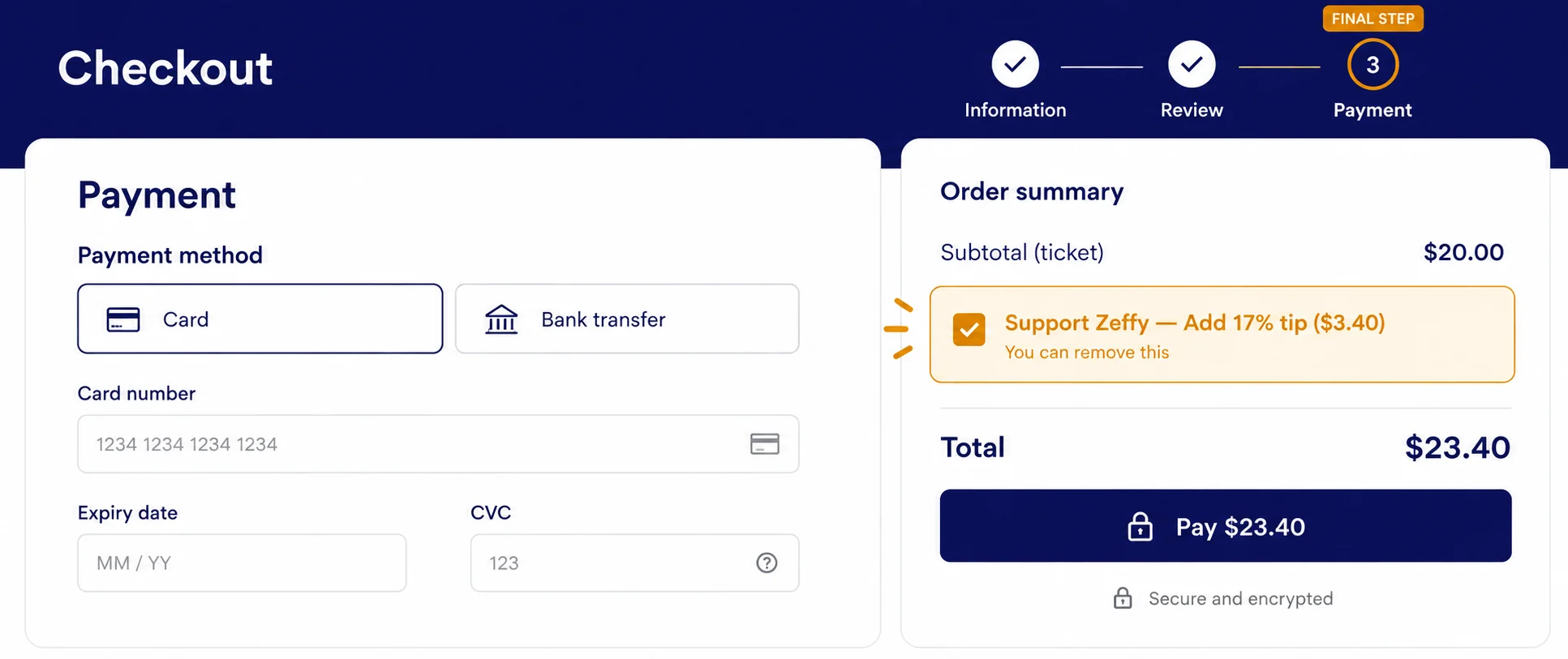 This matters because of where the tip appears in the purchase flow. Checkout abandonment research consistently shows that unexpected charges at the final payment step cause significantly higher abandonment than charges disclosed earlier in the process. The Baymard Institute reports that 48% of US shoppers have abandoned a cart due to unexpected costs at checkout. For charitable transactions where donors are already in a giving mindset and may feel social pressure not to remove the tip the psychology is particularly complex.
The abandonment data: what actually happens at checkout
The following abandonment rates represent incremental cart abandonment above the nonprofit baseline of approximately 7–8% (nonprofit buyers are more committed than average ecommerce shoppers). All figures are internally modeled across tens of thousands of transactions and corroborated by Baymard Institute, eMarketer (June 2024), Contentsquare 2025, and VWO 2026.Sources: internal modeling across tens of thousands of transactions · Baymard Institute (48% unexpected-fee abandonment) · eMarketer June 2024 · Contentsquare 2025 · VWO 2026. Nonprofit baseline ~7–8%. Figures represent incremental abandonment above baseline. Individual results vary; the direction does not.
The revenue math: what your organization actually receives
The most useful way to understand the real cost of any platform is to model what the organization receives after accounting for both the platform fee and abandonment. Here is that math at three fundraising goals.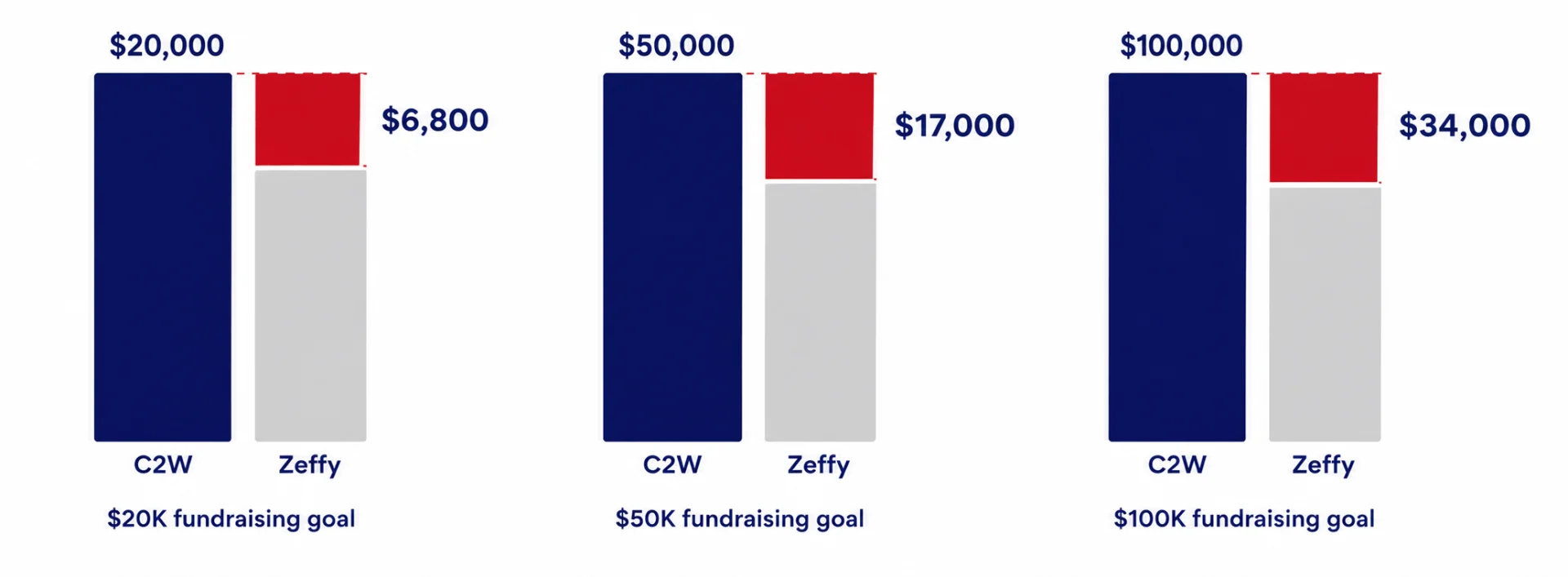
| Raffle Goal | Platform | Donor Charge Model | Org Receives | Gap vs. C2W |
|---|---|---|---|---|
| $20,000 | Chance2Win Zero Fee | Fixed 12%, disclosed upfront | $19,800 | — |
| Zeffy / tip model | Variable 17–29% tip, pre-checked | ~$13,000 | −$6,800–7,000 | |
| $50,000 | Chance2Win Zero Fee | Fixed 12%, disclosed upfront | $49,500 | — |
| Zeffy / tip model | Variable 17–29% tip, pre-checked | ~$32,500 | −$17,000 | |
| $100,000 | Chance2Win Zero Fee | Fixed 12%, disclosed upfront | $99,000 | — |
| Zeffy / tip model | Variable 17–29% tip, pre-checked | ~$65,000 | −$34,000 |
Figures use normalized modeling. Zeffy tip range per published checkout flow. Individual results vary; the direction does not. C2W Zero Fee org receives 100% of ticket revenue; 12% donor charge is paid by the donor, not deducted from proceeds. C2W Premium plan figures would show ~0% abandonment with flat fee deducted from org receipts.
The framing that clarifies this quickly: the "free" platform cost the cause $34,000. That is not a platform fee. That is the cost of donation abandonment caused by the tip prompt. The organization paid nothing. The cause paid everything.A caller came in looking to switch platforms after their basket raffle on a "free" platform underperformed. They had a goal of $40,000. The platform they used was technically free. Their donors saw a 22% tip prompt at checkout. When we looked at the data together, the abandonment was consistent with what we see across tip-based platforms. They had raised $28,000 not $40,000 on what should have been a strong raffle. The "free" platform had cost their cause more than $12,000 in unpurchased tickets. They ran the same raffle the following year through Chance2Win. They raised $41,000.
The lesson: Free isn't free. It just means somebody else is paying for it and in this case, that somebody is your cause.
Feature comparison: what you can and can't do on each platform
Beyond the pricing model, Zeffy and Chance2Win are different products for different situations. Zeffy is a general nonprofit fundraising tool that supports basic raffle ticket sales. Chance2Win is built specifically for raffle infrastructure and supports formats that Zeffy cannot.| Feature | Chance2Win | Zeffy |
|---|---|---|
| Traditional raffleOnline ticket sales, digital delivery, draw | ✓ | ✓ |
| Platform fee to orgZero Fee: $0 · Premium: from $329 flat | ✓ $0 | ✓ $0 |
| Donor charge modelHow supporters are charged | Fixed 12% disclosed upfront | Variable 17–29% tip, pre-checked |
| Cart abandonmentIncremental above nonprofit baseline | 1–2% (Zero Fee) / ~0% (Premium) | 30–40% |
| Basket raffle / tricky trayWallet model, per-basket allocation | ✓ Exclusive | — |
| Queen of Hearts raffleProgressive jackpot, weekly card reveal | ✓ Exclusive | — |
| Duck race / ball dropPre-numbered pool, live event | ✓ Exclusive | — |
| Hybrid drawing poolCash, check, and online in one pool | ✓ Exclusive | — |
| Payment gatewaysProcessor options | Stripe, Square, Authorize.net | Stripe only |
| Restricted prize supportWine, bourbon, cigars, similar prizes | ✓ Multi-gateway | Risk of suspension |
| Phone supportCall a real person when something is wrong | (813) 699-9325 | AI chatbot only |
| Compliance review at onboardingStructure reviewed before tickets go on sale | ✓ | Instant self-serve |
| US/Canada onlyGeographic availability | US only (excl. UT, HI) | US and Canada |
| 501(c)(3) required | Yes EIN verification | No |
When Zeffy actually makes sense
We said we would be honest, so here it is: Zeffy is appropriate for organizations where all of the following are true.- The raffle goal is under $5,000
- The format is a simple traditional draw no basket raffle, no Queen of Hearts
- The donor base is small, tight-knit, and already highly committed (low abandonment risk)
- The organization has no plans to run specialty formats now or in the future
- Phone support is not a priority
- The prize does not include alcohol, tobacco, or anything that might trigger Stripe's terms
What Chance2Win actually charges
Chance2Win has two plans. The framing that matters: the competitive argument is transparent fixed fee vs. variable guilt-tip not free vs. paid. Both plans are free to the organization in the sense that neither takes commissions from ticket revenue. Zero Fee plan: The organization pays $0. Donors pay a transparent, fixed 12% service charge disclosed clearly before the payment step not as a tip at the final moment. Because this charge is disclosed early and is a fixed amount (not a guilt-inducing "optional" add-on), incremental abandonment is approximately 1–2% above baseline. Premium plan: The organization pays a flat fee based on gross sales $329 for up to $5,000 in sales, $459 for up to $10,000, and $329 for each additional $10,000 block. The organization may optionally add a supporter charge most choose approximately 8%, and that 8% flows entirely to the organization, not to Chance2Win. With no tip prompt at checkout, incremental abandonment is approximately zero.The bottom line
The question is not "Is Zeffy free?" It is. The question is "What does free cost your cause?" A 30–40% abandonment rate on a $50,000 fundraising goal translates to roughly $17,000 in donations your organization never received not because supporters didn't want to give, but because a checkout friction moment stopped them. The platform cost was zero. The fundraising cost was not. We have run so many raffles over the years that we honestly stopped counting. What we have not stopped doing is watching organizations leave money on the table because they optimized for platform cost instead of fundraising outcome. Measure what you raise, not what you pay. If you are running a serious raffle anything over $5,000, any specialty format, any audience where trust and simplicity at checkout matter we believe the math points clearly toward transparent fixed-fee pricing. The free tool on this site is yours to use regardless. And if you need a full platform, Chance2Win is where to go.Start with the free draw tool. Then talk to us about the full picture.
No obligation. We answer the phone at (813) 699-9325 and we are happy to model the math for your specific situation.