How to run a raffle online everything you actually need to know.
Seven steps, zero filler. We've been running online raffles for nonprofits since before most fundraising platforms existed. This is what we tell every organization that calls us minus the part where we let you ramble for ten minutes before we figure out what you're actually asking.
The no-purchase-necessary rule
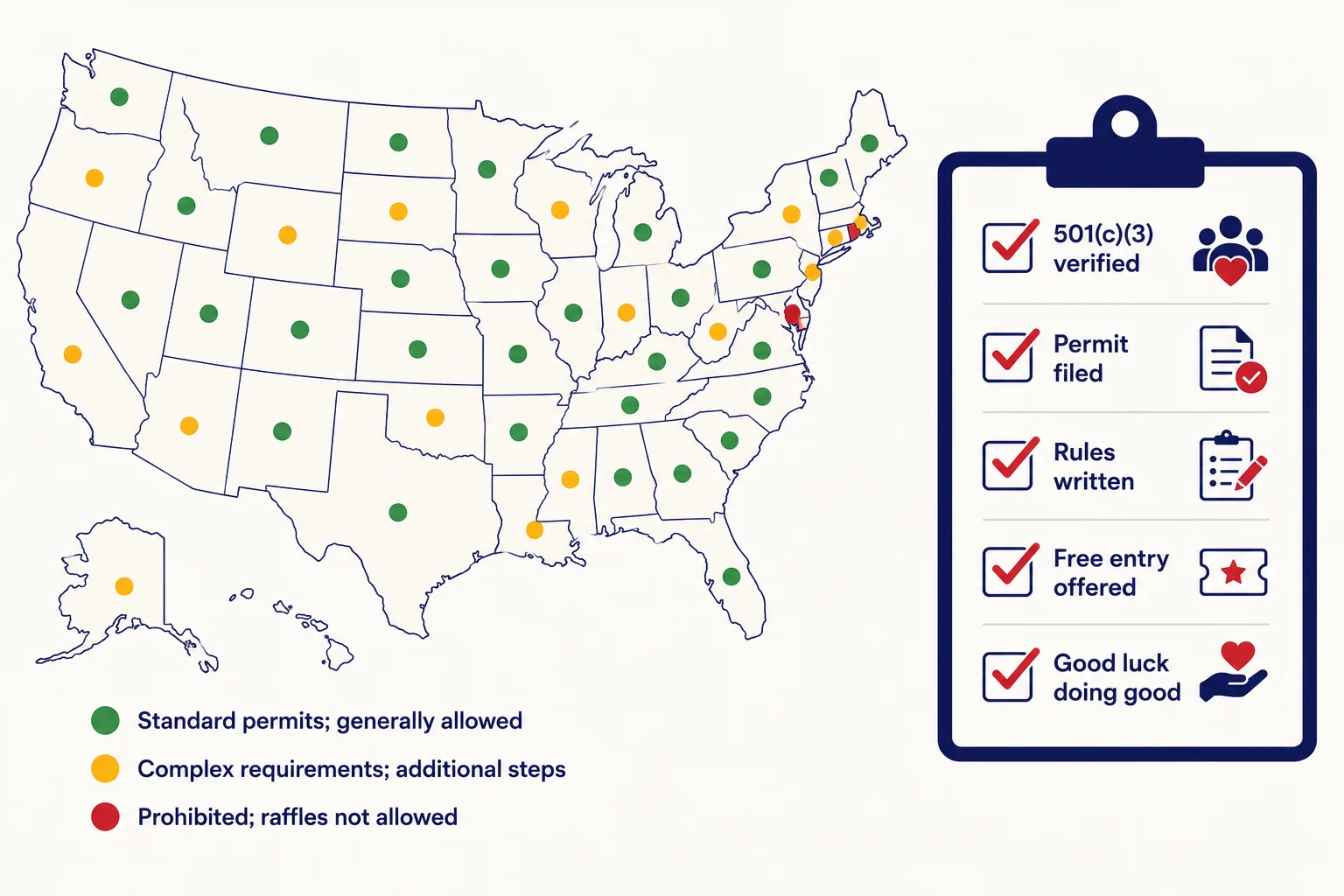
If your raffle accepts entries across state lines and online raffles almost always do US consumer protection law requires you to offer a free entry method. The standard approach: publish a mail-in address where participants can send a self-addressed, stamped envelope with their name and contact information to receive a free entry. You do not need a free online entry form. Just a viable physical alternative. Include this in your official rules and on your raffle page.Raffle and charitable gaming laws vary by state this is not legal advice. Consult a licensed attorney in your jurisdiction before conducting a raffle or fundraising activity.
- Traditional raffle All tickets in one pool, one or more prizes drawn at the end. The most common format. Simple to explain, scalable from small PTAs to citywide campaigns. Best for: short campaigns (4–6 weeks), audiences who want a clear shot at a specific prize.
- Basket raffle (tricky tray / Chinese auction) Multiple prize baskets, each with its own ticket allocation. Supporters buy a ticket balance and spread entries across baskets they want. Best for: live events and galas where the browsing and choosing is part of the fun. Can also run online with the right platform.
- 50/50 raffle Winner takes half the total ticket sales; organization keeps the other half. Simplest format of all. Best for: sports events, banquets, anywhere with a captive audience and limited setup time.
- Queen of Hearts Progressive weekly raffle using a 54-card deck. Best for: organizations with large, loyal audiences who want sustained multi-week engagement. Not recommended if your supporter base is under a few hundred active people. The jackpot only grows if weekly ticket volume is consistent.
A caller wanted to run a Queen of Hearts raffle and make millions. Support asked how big their supporter base was. "Oh, we should do great." How many followers on social media? "About 25 people on Facebook." Queen of Hearts raffles work through momentum the first few weeks might be quiet, then people start talking, the jackpot grows, local media picks it up. That momentum requires volume to start. With 25 Facebook followers, you don't have enough fuel to get it going. Start with a traditional raffle. Build the audience. Then bring out the deck.
Get the prize in writing first
Never advertise a prize you don't have confirmed in writing. We have fielded the call where an organization was selling tickets for a motorcycle that belonged to someone's uncle who "said we could probably use it at a barbecue." That is not a prize. That is a potential legal problem and an extremely awkward refund conversation. Get a written donation agreement before the raffle launches. Two more prize-related warnings from experience: first, high-value prizes (anything over $600) will require you to issue a W-2G form to the winner and potentially withhold taxes. Disclose tax responsibility clearly in your rules before anyone buys a ticket. Finding out after winning a $15,000 car that you now owe taxes on $15,000 of income is not the experience you want to create. Second, specific experience prizes spa days, specialty experiences can create complications if the winner has restrictions or allergies. Choose prizes that can be transferred or substituted if needed.Official rules what must be in them
Your official rules document is both a legal requirement and your protection if anything goes sideways. At minimum, include:- Organizer's legal name and tax ID
- Raffle period (start and end dates)
- Eligibility requirements (state(s), age, exclusions)
- Entry methods, including the required free mail-in option
- Drawing date and location (or live-stream details)
- Prize description, approximate retail value, and delivery method
- Odds statement ("Odds of winning depend on number of entries received")
- Tax disclosure ("Winners are responsible for all applicable taxes")
- Publicity consent clause
- Official contact name, email, and phone
The two honest options for nonprofits
Chance2Win builds and hosts a complete raffle website for your organization. You handle promotion; they handle everything technical compliance review, payment setup, ticket numbering, entry management, and the final draw. No coding required. Available to 501(c)(3) nonprofits with EIN verification. Launches in days. Supports all four major raffle formats. US-based phone support at (813) 699-9325. WPRaffle is a WordPress/WooCommerce plugin a perpetual license, self-hosted on your own server. For organizations with a WordPress developer. Silver, Gold, and Platinum editions with increasing feature depth.Platform setup checklist
- Payment processor configured and tested (Stripe, Square, or Authorize.net)
- Ticket pricing and bundle options set (1 for $10, 5 for $40, etc.)
- Prize photos uploaded clear, professional images of the actual prize
- Official rules linked on the raffle page
- Test purchase completed do not skip this step
- Raffle funds in a separate account or clearly separated in accounting
- Drawing date and method disclosed on the page
The three-phase promotion plan
Phase 1: Pre-launch (2–3 weeks before sales open) Tease the prize without revealing everything. "Something exciting is coming to support our local heroes…" Build an email list. Create a sense of anticipation. Get your committee aligned before the public launch so your initial promotional push is coordinated, not scattered across 14 people in a group text. Phase 2: Active campaign (4–6 weeks of ticket sales) 2–3 social posts per week, one email announcement and one follow-up per week, and at least one visual update (prize photo, progress update, supporter story) every week. Post your current ticket sales total. People buy when they see other people buying. Display the live jackpot if your format supports one. Phase 3: Final push (last 5–7 days) This is when urgency becomes your tool. "48 hours left." Post screenshots of your progress. Tag recent buyers (with permission). A flash sale with a small bonus prize for purchases in a specific window can spike late-stage sales significantly.A youth soccer league in Georgia ran a raffle for sports equipment donated by local sponsors. They tracked digital tickets, encouraged social sharing, and assigned purchases to individual team members as a friendly competition. Sales were going well locally then Grandma started showing her QR code at the beauty salon. Orders started coming in from across the Midwest, including from Potosi, Wisconsin a city nobody on the team had even heard of. The raffle raised $12,000–$16,000 selling $10 tickets. The marketing budget was approximately zero. The Grandma Effect is real. Your most passionate supporters will share further than any paid ad.

Ticket pricing and bundles
After nearly 20 years of analyzing raffle data, one pattern holds consistent: bundle pricing dramatically increases average order value. Single-ticket pricing averages roughly $11 per order. Bundle pricing three tickets for $25, ten for $50, twenty-five for $100 pushes average orders to $60–70. The tickets themselves have no intrinsic value until they're sold. Selling ten tickets at $60 raises far more than selling one at $10. Build bundles that feel like obvious value, and make the largest bundle the most prominent option on the page.Before you draw
- Confirm ticket sales are closed at the exact posted deadline. Not "close enough." The deadline you published is the deadline.
- Combine all entries online purchases, mail-in free entries, and any in-person sales into one official list. Everyone in the pool equally.
- Designate two independent witnesses who are not raffle participants.
- Record the process a phone camera recording is sufficient for most situations. Someone will ask later.
The draw itself
Use the draw tool on this site for a verifiable result with a public record, or use the Chance2Win platform's automated draw feature which logs everything automatically. The verify link you share with participants lets anyone confirm the entry count, timestamp, and winning result independently no one has to take your word for it.Announcing the winner
Contact the winner privately before posting publicly. No one wants to find out they won by seeing their name tagged on Facebook before getting a phone call. Once confirmed, post the announcement but do it properly. First name and last initial only unless they explicitly consent to full name publication. If you can get a photo of the prize presentation, use it. The single most effective thing you can do for next year's raffle participation is a smiling winner holding their prize with a link to the verify record beside it.- Download your sales data immediately after the draw. Every platform generates a CSV export. Download it to a shared drive where multiple people have access, not just one volunteer's laptop.
- File post-raffle reports if your state requires them. Many do. Check your permit paperwork for the filing deadline.
- Issue W-2G forms for prizes valued over $600. This is an IRS requirement, not optional.
- Retain records for at least three years ticket numbers sold, sales totals, expenses, prize delivery confirmation. Some states require longer retention periods.
- Conduct a debrief while the experience is fresh. What worked, what didn't, what would you change next time. Write it down. The team changes, the institutional knowledge doesn't have to.
We've run so many raffles we honestly stopped counting. We never stopped answering the phone.
If you have a question about any of the steps above permits, platform choice, pricing, format call us. That's what the number is for.